
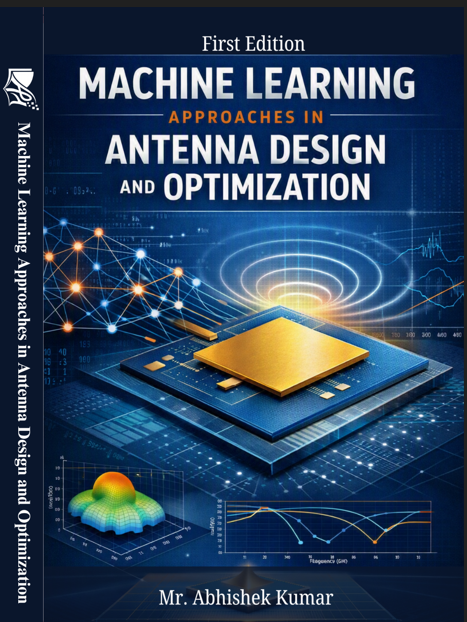
Machine Learning Approaches in Antenna Design and Optimization explores the application of machine learning and computational intelligence to the analysis, modelling, prediction, and optimization of antenna systems. The book is developed around the changing requirements of contemporary wireless engineering, where antenna designs must frequently satisfy multiple performance objectives while maintaining practical restrictions related to size, geometry, materials, fabrication, cost, and operating environment.
The book begins with the fundamental relationship between antenna engineering and machine learning, establishing the concepts required to understand data-driven antenna modelling. It examines important antenna-design variables, performance measures, and engineering constraints before progressing toward the preparation and use of datasets generated through electromagnetic simulations or experimental investigations. Particular attention is given to the relationship between input design parameters and antenna responses, which forms the basis for developing predictive machine-learning models.
Different machine-learning approaches are considered in the context of antenna applications, including regression techniques, artificial neural networks, surrogate models, evolutionary computation, and optimization-based methods. The discussion also addresses model training, validation, performance assessment, feature selection, and the challenges associated with limited or computationally expensive electromagnetic datasets.
A central theme of the book is optimization. Antenna design frequently involves several competing objectives, such as maximizing gain and bandwidth while reducing physical dimensions and maintaining acceptable impedance matching and radiation characteristics. Machine-learning-assisted optimization can help navigate these complex design spaces more efficiently than exhaustive parameter sweeps. The book therefore examines intelligent optimization strategies and their integration with electromagnetic simulation workflows.
Applications across modern wireless and high-frequency systems provide context for the methodologies discussed throughout the book. The material is designed for undergraduate and postgraduate students, researchers, antenna engineers, and professionals seeking an academic and practical understanding of machine-learning-assisted antenna design. By connecting electromagnetic principles with data-driven computational methods, the book presents a foundation for developing more efficient, adaptive, and automated approaches to antenna engineering.
Books
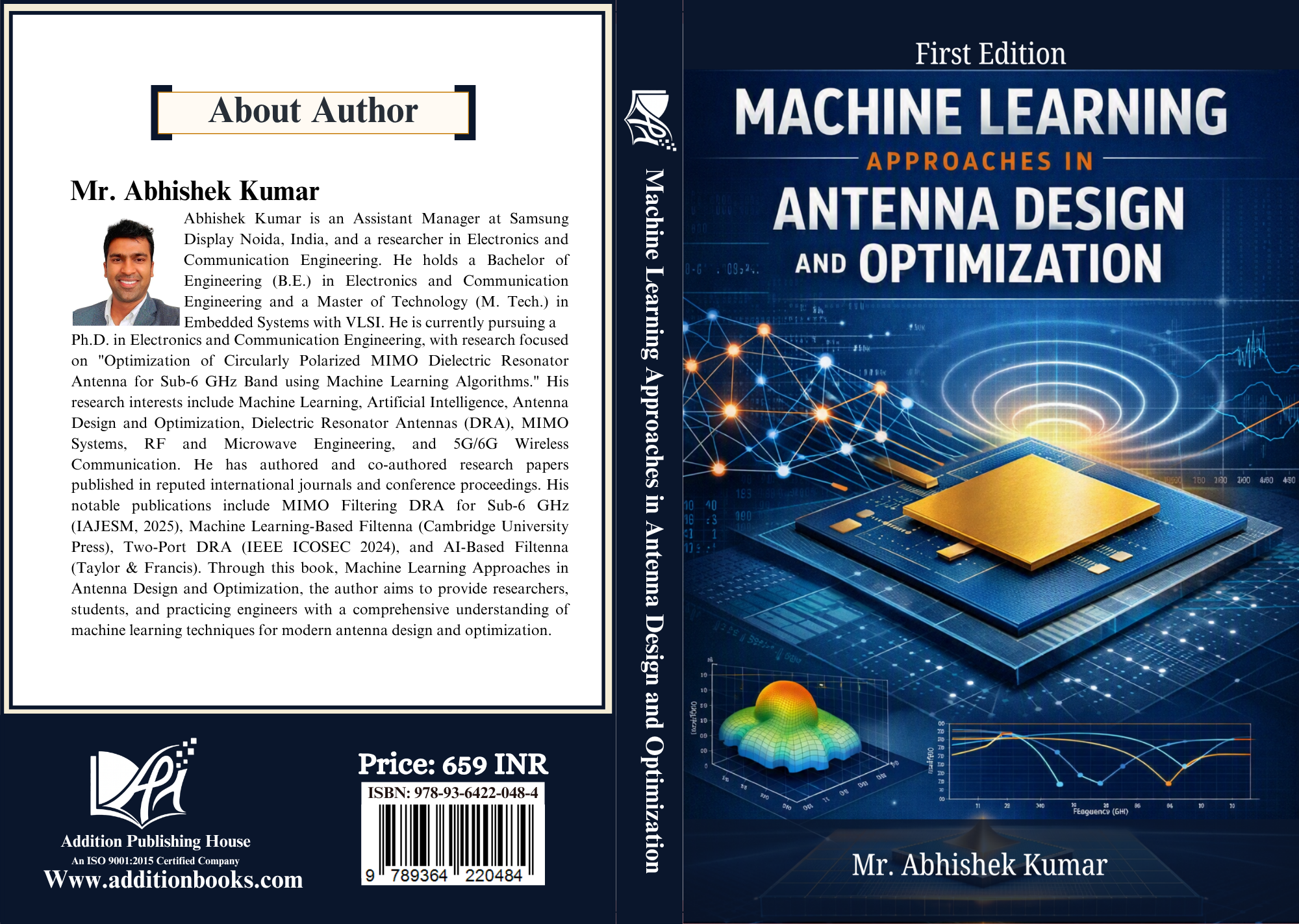
Machine Learning Approaches in Antenna Design and Optimization
₹659.00
| AUTHOR | Mr. Abhishek Kumar |
|---|---|
| ISBN | 978-93-6422-048-4 |
| Language | English |
| Pages | 196 |
| Publication Year | 2026 |
| Binding | Paperback |
| Publisher | Addition Publisher |



Reviews
There are no reviews yet.