
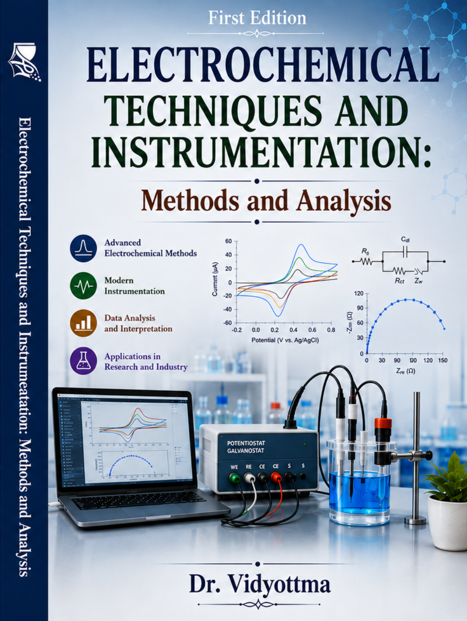
Electrochemical Techniques and Instrumentation: Methods and Analysis provides a comprehensive and application-oriented treatment of electrochemical principles, analytical techniques, instrumentation, and data interpretation. The book begins with the fundamental concepts of electrochemical systems, including oxidation-reduction reactions, electrode potentials, electrochemical cells, thermodynamic principles, electrode interfaces, and the movement of ions and electrons. These foundations provide the basis for understanding the behavior of practical electrochemical systems.
The book examines the major electrochemical techniques used for qualitative and quantitative analysis. Potentiometric methods are discussed in relation to ion-selective electrodes, pH measurement, reference electrodes, and direct electrochemical measurements. Conductometric techniques are explored through ionic conductivity, cell constants, conductometric titrations, and analytical applications. Amperometric and coulometric methods are examined with emphasis on current measurement, electrolysis, quantitative determination, and analytical sensitivity.
A substantial portion of the book focuses on voltammetric techniques, including linear sweep voltammetry, cyclic voltammetry, pulse voltammetric methods, and stripping techniques. The relationship between applied potential, current response, electrode kinetics, diffusion, and analyte concentration is explained to help readers understand how electrochemical signals are generated and interpreted. Electrochemical impedance spectroscopy is also introduced as an important method for investigating charge-transfer resistance, double-layer behavior, diffusion processes, coatings, batteries, sensors, and material interfaces.
The instrumentation component covers working, reference, and counter electrodes; potentiostats and galvanostats; electrochemical cells; signal conditioning; data acquisition; calibration; and experimental parameters that influence measurement quality. Consideration is given to electrode fouling, background currents, noise, interference, sensitivity, selectivity, accuracy, precision, and reproducibility.
The book further explores advanced electrode modification using nanomaterials, conducting polymers, composites, and surface-functionalization strategies. Applications in electrochemical sensors and biosensors, pharmaceutical and clinical analysis, environmental monitoring, corrosion assessment, energy-storage systems, and industrial process control demonstrate the practical importance of these techniques.
Emerging areas such as miniaturized electrochemical devices, flexible and wearable sensors, microfluidic electrochemistry, artificial intelligence-assisted electrochemical data analysis, and sustainable electrochemical technologies are also addressed. Through theoretical explanations, equations, experimental principles, analytical examples, and application-based discussions, this book serves as a valuable resource for students, researchers, laboratory scientists, and professionals seeking a strong understanding of electrochemical techniques and modern instrumentation
Books
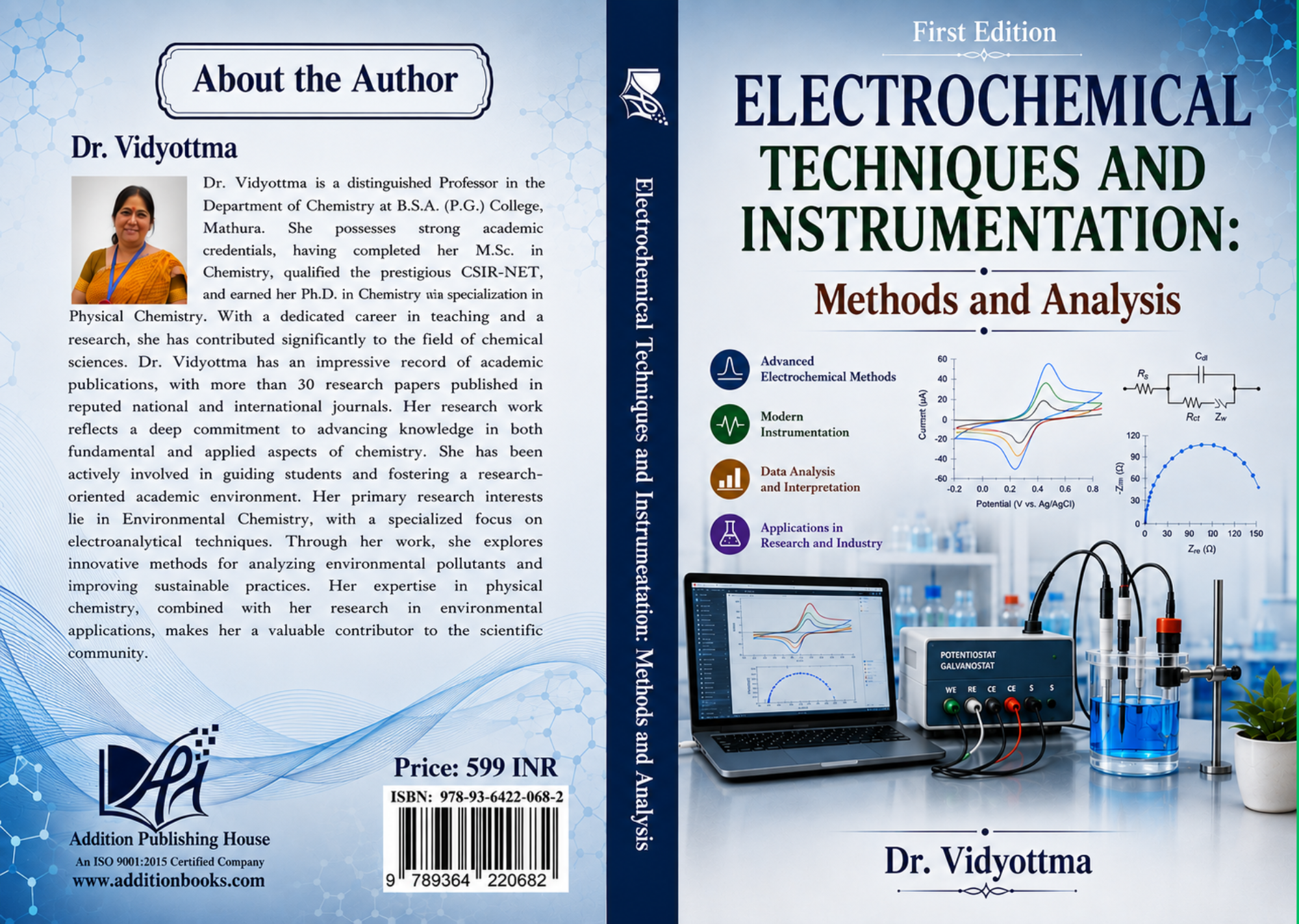
Electrochemical Techniques and Instrumentation: Methods and Analysis
₹599.00
| AUTHOR | Dr. Vidyottma |
|---|---|
| ISBN | 978-93-6422-068-2 |
| Language | English |
| Pages | 215 |
| Publication Year | 2026 |
| Binding | Paperback |
| Publisher | Addition publishing house |



Reviews
There are no reviews yet.