
Nanoscience and nanotechnology have emerged as pivotal scientific domains that reconfigure our understanding of matter, energy, and functionality at the smallest scales. Advances in Nanoscience and Nanotechnology has been written to serve as an extensive, multifaceted resource that captures the breadth and depth of this expansive field while presenting its concepts in a manner that is accessible, integrative, and forward-looking. The book’s development stems from the recognition that nanoscale science is not an isolated discipline but rather an interconnected network of physics, chemistry, biology, computation, and engineering. Its overarching goal is to offer readers a holistic understanding of how nanoscale phenomena are discovered, analyzed, manipulated, and harnessed for technological advancement. The book begins by establishing a detailed conceptual foundation, explaining the principles that distinguish nanoscale materials from their bulk equivalents. By carefully unpacking the significance of surface-to-volume ratio, size-dependent quantum effects, electronic transitions, and structural reconfiguration at the atomic level, the text allows readers to appreciate the scientific novelty inherent in the nanoscale domain. This framework lays the groundwork for exploring advanced topics such as quantum confinement, nanoscale reactivity, molecular self assembly, and emergent electronic and optical behaviors. The intention is to construct knowledge progressively, ensuring that even readers with limited scientific backgrounds can engage deeply with the subject matter while allowing advanced learners to refine their conceptual understanding. The second major section of the book focuses on synthesis techniques, which represent the heart of nanotechnology research. The text discusses both top-down and bottom-up approaches, examining mechanical milling, lithographic patterning, plasma processing, sol-gel chemistry, hydrothermal synthesis, chemical vapor deposition, molecular beam epitaxy, and advanced self-assembly strategies. Each approach is presented in a detailed, stepby- step narrative that explains its governing mechanisms, procedural intricacies, and application-specific suitability. Emphasis is placed on the ways in which reaction parameters, precursor materials, thermodynamic conditions, and kinetic constraints influence the properties of the final nanostructures. The aim is to help readers develop a strong appreciation of synthesis–structure– property relationships, which forms a crucial intellectual bridge between theoretical science and practical engineering.
Books
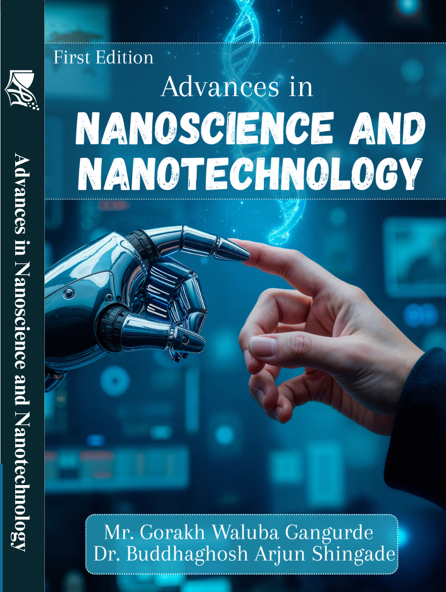
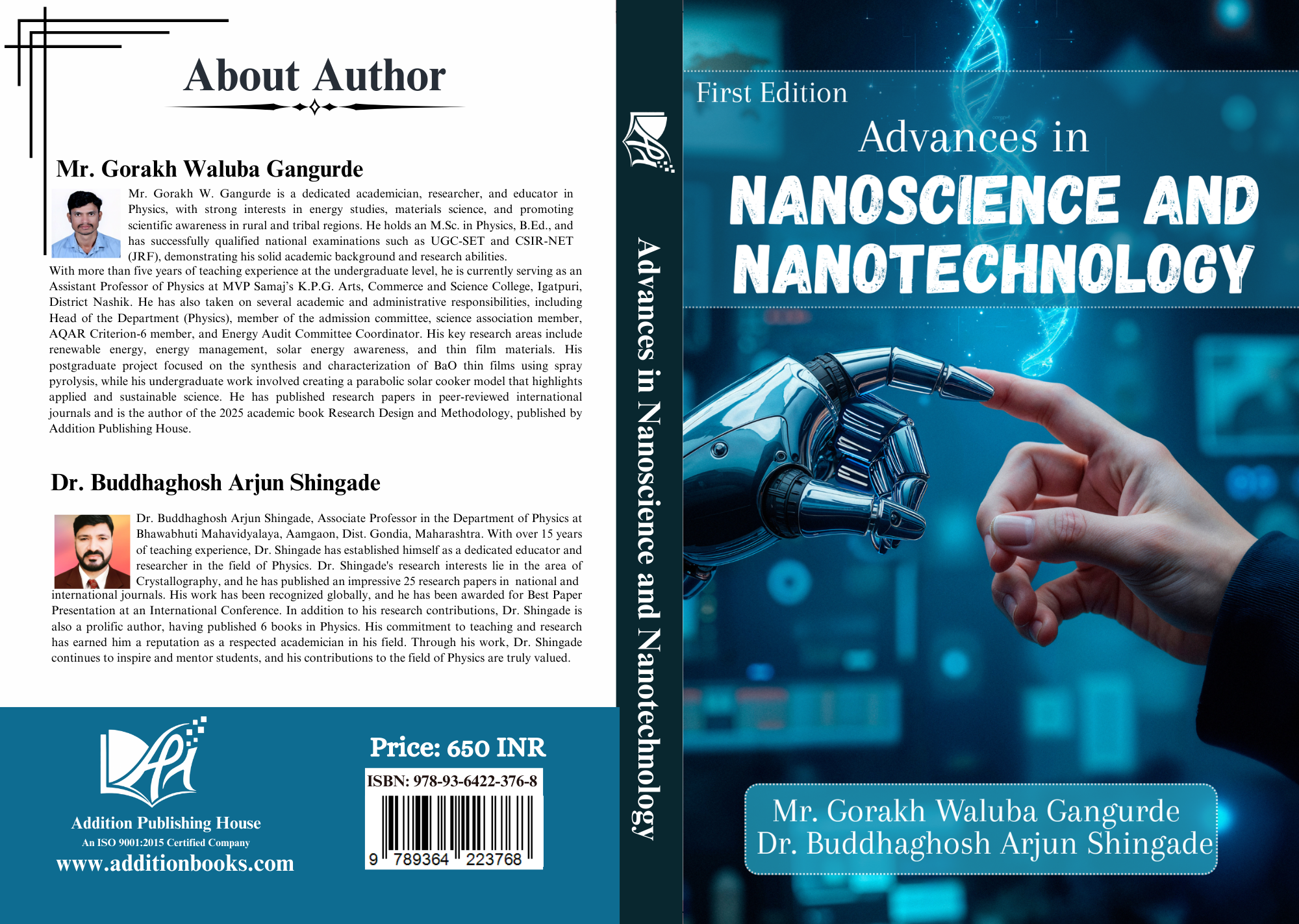
Advances in Nanoscience and Nanotechnology
₹650.00
| AUTHOR | Mr. Gorakh Waluba Gangurde, Dr. Buddhaghosh Arjun Shingade |
|---|---|
| ISBN | 978-93-6422-376-8 |
| Language | English |
| Pages | 208 |
| Publication Year | 2025 |
| Binding | Paperback |
| Publisher | Addition Publisher |

Reviews
There are no reviews yet.