
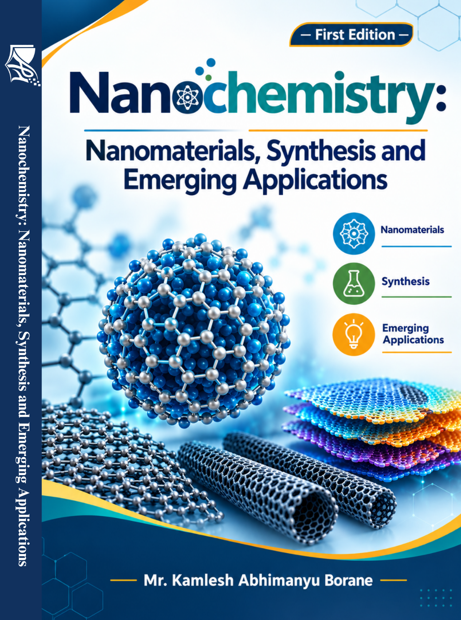
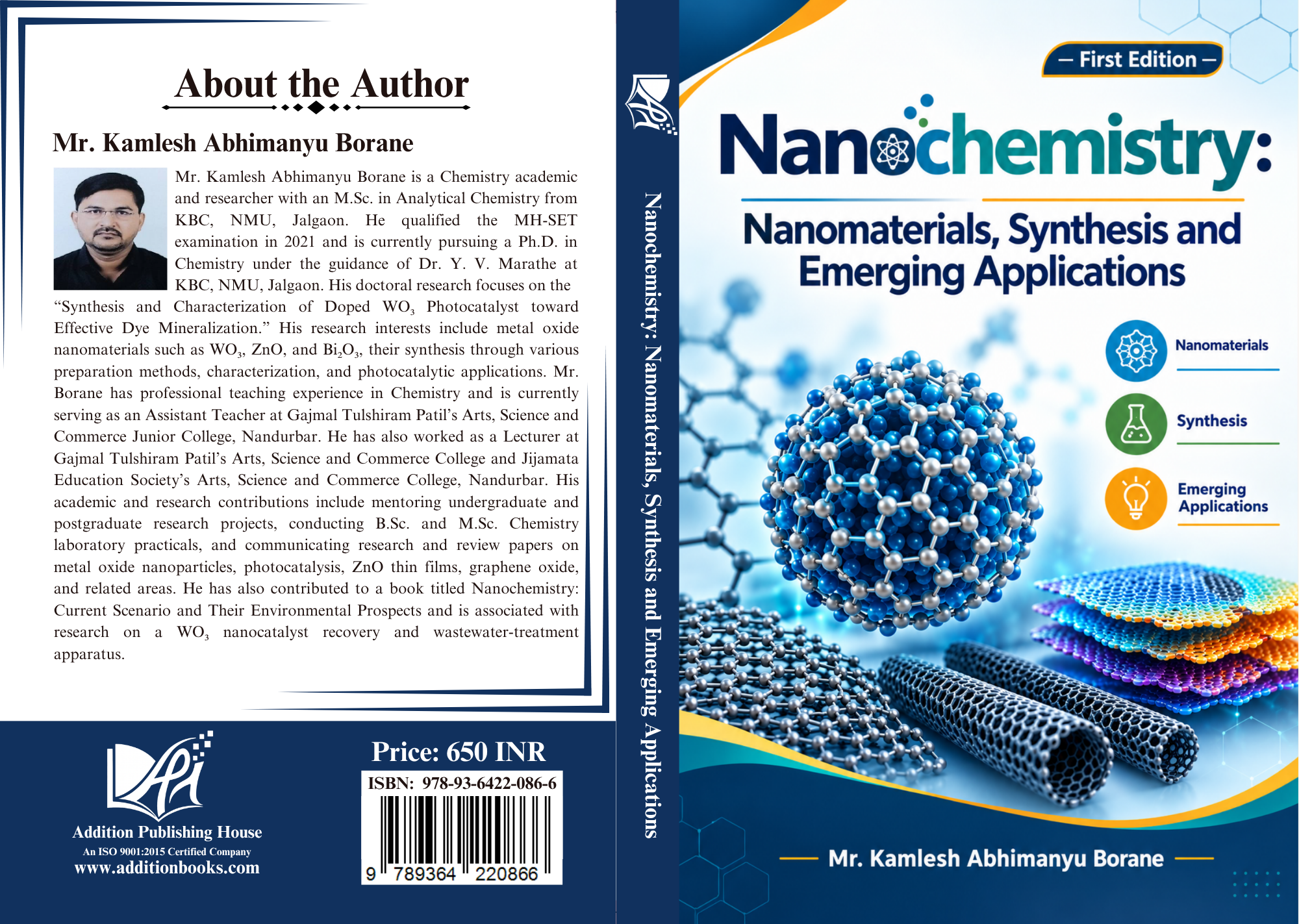
Nanochemistry: Nanomaterials, Synthesis and Emerging Applications provides an integrated introduction to the chemical principles, synthesis strategies, characterisation methods, properties, and applications of nanoscale materials. The book is designed to help learners understand how changes in dimensions, surface characteristics, composition, morphology, and structure at the nanoscale influence the chemical and physical behaviour of materials.
The book begins with the foundations of nanochemistry, including the meaning and scope of nanoscience, nanoscale dimensions, size-dependent properties, surface-to-volume effects, quantum confinement, and the relationship between structure and properties. These concepts provide the theoretical basis for understanding why nanomaterials exhibit distinctive optical, electrical, magnetic, mechanical, thermal, and catalytic behaviour.
The subsequent sections examine major classes of nanomaterials. Metallic nanoparticles, metal-oxide nanoparticles, carbon-based nanomaterials, semiconductor nanomaterials, nanocomposites, and other functional nanostructures are discussed in terms of their composition, structure, properties, preparation, and technological significance. Attention is given to the ways in which particle size, shape, morphology, surface chemistry, and crystallinity influence material performance. A major focus of the book is nanomaterial synthesis. Both top-down and bottom-up approaches are introduced, followed by physical and chemical synthesis techniques and emerging biological and green synthesis methods. The role of reaction parameters and stabilising or reducing agents is discussed to explain how controlled synthesis can produce nanomaterials with desired characteristics. The book also introduces important characterisation approaches used to examine nanoscale materials, including microscopy, diffraction, spectroscopy, and techniques for determining particle size, morphology, surface properties, and optical behaviour.
The application-oriented sections demonstrate the relevance of nanochemistry to contemporary technological challenges. Nanocatalysis and photocatalysis are discussed in relation to chemical transformation and environmental applications, while nanomaterials for water purification and environmental remediation illustrate their role in addressing pollution and resource-management challenges. The book also explores applications in nanoelectronics, photonics, advanced sensors, energy technologies, nanomedicine, drug delivery, and nanotheranostics.
Particular emphasis is placed on the connection between synthesis, structure, properties, and application. Rather than treating nanomaterials as isolated categories, the book encourages learners to understand how chemical design at the nanoscale determines functional performance.
Books
Nano chemistry: Nanomaterials, Synthesis and Emerging Applications
₹650.00
| AUTHOR | Mr. Kamlesh Abhimanyu Borane |
|---|---|
| ISBN | 978-93-6422-086-6 |
| Language | English |
| Pages | 219 |
| Publication Year | 2026 |
| Binding | Paperback |
| Publisher | Addition publishing house |



Reviews
There are no reviews yet.